


NFPA 855 Battery Storage: The Blueprint for Safe Energy Resilience
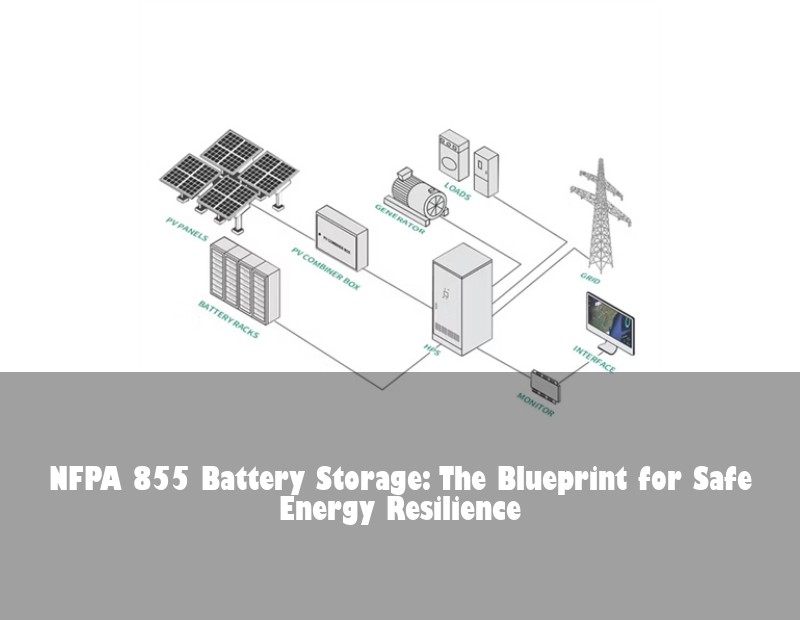
As Europe accelerates its renewable transition, large-scale battery storage systems (BESS) have become critical infrastructure. But with high-energy density batteries comes inherent fire risks – a concern tragically highlighted by recent incidents in South Korea and Arizona. This is where NFPA 855 battery storage standards emerge as the global safety cornerstone, transforming how we design, install, and operate energy storage. Let's explore why this U.S.-developed standard is reshaping European energy security.
Table of Contents
- What is NFPA 855 and Why is it Non-Negotiable?
- Core Safety Requirements: Breaking Down the Technicalities
- European Reality Check: A UK Case Study in Compliance
- The Compliance Tightrope: Balancing Safety and Costs
- Beyond Today: How NFPA 855 is Shaping Global Standards
What is NFPA 855 and Why is it Non-Negotiable?
The phenomenon: Lithium-ion battery fires release toxic gases and burn at 1,000°C+ – traditional firefighting methods often worsen them. Yet over 90% of new BESS installations use this chemistry (source: Energy Storage News).
NFPA 855 solution: Developed by the U.S. National Fire Protection Association, this standard provides the first unified framework for battery storage safety. It mandates:
- Strict energy capacity limits per installation zone
- Mandatory thermal runaway containment systems
- Fire-rated separation between battery units
European regulators increasingly reference NFPA 855 because it addresses risks other standards overlook. Think of it as the "structural engineer" for your battery project – you wouldn't build skyscraper without one.
Core Safety Requirements: Breaking Down the Technicalities
Let's demystify key technical mandates:
Separation Distances: The Invisible Safety Cushion
NFPA 855 requires minimum distances between battery arrays and occupied buildings – typically 3 meters for indoor systems. This isn't arbitrary; it's based on toxic gas dispersion models. Installers often use firewalls as physical alternatives.
Thermal Runaway Management: Stopping Chain Reactions
When one cell overheats, it can trigger catastrophic failures. NFPA 855 mandates:
- Continuous temperature monitoring with 2+ sensors per rack
- Explosion venting for containerized systems
- Automated deluge systems tested for lithium fires (not just water!)
Emergency Response: Your Fire Department's Playbook
Standardized shutdown procedures and onsite hazard placards are required. Why? During the 2019 McMicken fire in Arizona, firefighters waited 7 hours to approach the site due to unknown risks (source: NFPA Journal).
European Reality Check: A UK Case Study in Compliance
The challenge: In 2022, a 40MW solar+storage project in Essex faced approval delays due to unclear safety protocols.
NFPA 855 implementation: The developer redesigned the layout to:
- Reduce single-zone capacity from 2.5MWh to 1.7MWh (below NFPA thresholds)
- Install 3-tiered fire suppression (chemical, water mist, and gas-based)
- Add hydrogen detection sensors – a non-requirement in older EU guidelines
Results: Project commissioning accelerated by 5 months after local authorities recognized NFPA 855 compliance. This reflects a broader trend: 68% of European BESS projects now use NFPA 855 as primary safety reference (per PV Magazine Europe 2023 survey).
The Compliance Tightrope: Balancing Safety and Costs
While essential, NFPA 855 introduces complexities:
- Space penalties: Separation requirements can increase land use by 15-25%
- Monitoring costs: Multi-sensor systems add ~€4/kWh to installations
- Firefighter training gaps: Only 12% of EU fire departments have lithium-specific protocols (EU Fire Safety Forum)
The solution? Start safety integration before site selection. Many European developers now use augmented reality tools to simulate fire spread during design phases.
Beyond Today: How NFPA 855 is Shaping Global Standards
NFPA 855 evolves with technology:
- 2023 updates address flow battery safety – previously overlooked
- New annexes for second-life EV batteries in storage systems
- Harmonization with IEC 62933-5-2 for international projects
As Europe targets 200GW of storage by 2030, NFPA 855 provides the technical "common language" between German engineers, Spanish regulators, and French fire services.
How will your next storage project embed safety-by-design to meet these evolving benchmarks? Share your approach – we're all learning in this critical energy transition.
 Inquiry
 Online Chat